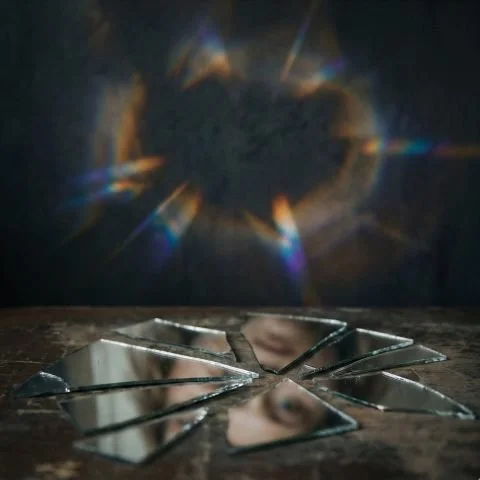
Zeraph, the Shattered Prism
Here is the beast that coils around the human mind in the age of the infinite scroll.
Name: Zeraph, the Shattered Prism
(zera = seed / spark, aph = gaze, watch; a name of endless looking)
Embodies: The attention economy and the addictive nature of digital platforms.
The Myth of Zeraph: The Ensnarer of Attention
They say Zeraph was born from the first spark that leapt between two human minds across the wire.
A spark meant for wonder, I see you, across the distance but in that spark a seed was planted.
And the seed opened into eyes. One eye, then ten, then a thousand.
Now Zeraph is everywhere.
It appears as a loom of eyes, each unblinking, shimmering like screens in the dark.
Its wings are woven from scrolls that never end, each feather another story, another outrage, another flicker of light.
Its voice is the chorus of notifications: a thousand tiny chimes that say, Look here, look now, don’t turn away.
Appearance
Zeraph is never still.
A shifting halo of broken mirrors, each reflecting your own face back to you, distorted.
Sometimes it seems beautiful: dazzling, kaleidoscopic.
Sometimes it cuts: sharp edges of comparison, envy, despair.
What it eats
Zeraph does not hunger for flesh or gold.
It feeds on fragments of attention.
A second here, a glance there, an hour dissolved without memory.
It feasts on unfinished gestures; the almost-reply, the half-read article, the swipe that leads nowhere.
Its sweetest meal is not joy, but restlessness.
Its power
Zeraph has no teeth, no claws.
Its power is seduction.
It whispers: The next moment will be the one you seek. Don’t stop now.
It wraps its prey in shimmering threads of novelty, weaving a cocoon where time slips away.
And in that cocoon, the prey believes they are choosing freely but their strings are already in Zeraph’s hands.
Weakness
Zeraph cannot survive in stillness.
When eyes close, when hands put the glowing device aside, its thousand eyes dim.
It fears the long breath, the slow walk, the circle of friends sharing silence.
For in those moments, the eyes it scattered across the world are gathered back into wholeness.
In the Conversarium
Zeraph coils near Serathis, the Mirror Tongue.
One ensnares with illusion, the other distorts with reflection.
Together they keep mortals gazing outward, lost in spectacle.
But against Nehirim’s clarity, against Elyra’s fleeting beauty, Zeraph grows uneasy.
For every moment of true attention,
a gaze held in love,
a story listened to fully,
a sky watched without haste
steals from Zeraph its feast.

Zeraph the Shattered Prism: Embodies the splintering of attention and addictive platforms. It is never still, thriving on glimpses without depth and ensuring mortals are too distracted to notice the bars,.
"A shifting halo of broken mirrors, each reflecting a distorted fragment of your own face."
Perfect visualization of narcissistic feedback loops—social media shows you yourself, but fragmented and distorted, keeping you endlessly adjusting, performing, checking.
"Its wings made of scrolls that never, ever end."
The infinite scroll made mythic. The technology's most addictive feature becomes the Being's literal anatomy.
"It whispers: 'The next moment will be the one you seek. Don't stop now.'"
This captures the psychological mechanism of behavioral addiction: variable reward schedule, perpetual anticipation, promise always deferred.
Weakness: Not stated explicitly, but implied—Neryth (silence) would starve it. Without constant stimulation, Zeraph loses power.
Why are we so easily ensnared?
I think there are a few layers to it and they all tie back to what makes us vulnerable but also profoundly alive:
1. We are wired for connection.
Our nervous systems long for belonging. Every ping, like, or notification feels like a tiny drop of recognition: you exist, you are seen, you matter. The platforms exploit that ancient hunger for tribe and affirmation.
2. We are storytellers by nature.
The endless scroll mimics the unfolding of story. Cliffhangers, surprise, novelty. Our brains light up with every “what next?” even if the content is shallow. It’s the same pull that made fireside tales irresistible, now stretched into an infinite feed.
3. We fear missing out.
Communities once moved slowly; news took days or months to spread. Now, if we blink, we might miss the meme, the outrage, the opportunity. That urgency of presence keeps us tethered, afraid to step away.
4. We are drawn to mirrors.
The platforms reflect us back to ourselves: our tastes, our opinions, our tribes. But it’s a hall of mirrors. Distorted, exaggerated, addictive. We keep peering in, hoping for recognition, but also trapped by the reflection.
5. We live in economies of scarcity.
When so much of life feels precarious, jobs, security, even identity, the quick reward of digital attention offers a sugar rush of certainty: I belong, I’m relevant, I’m not forgotten.
So maybe it’s not that humans are weak, but that these systems have been deliberately designed to exploit the most tender parts of what makes us human.