Let us walk the earth with the slow thunder of memory.
Let us meet the elephant, not as symbol or spectacle,
but as one who remembers the shape of water,
who carries Velin not in books,
but in muscle, tusk, and tread.
The Elephant and the Dust
A Story in Liora, Told in the Language of Kinship
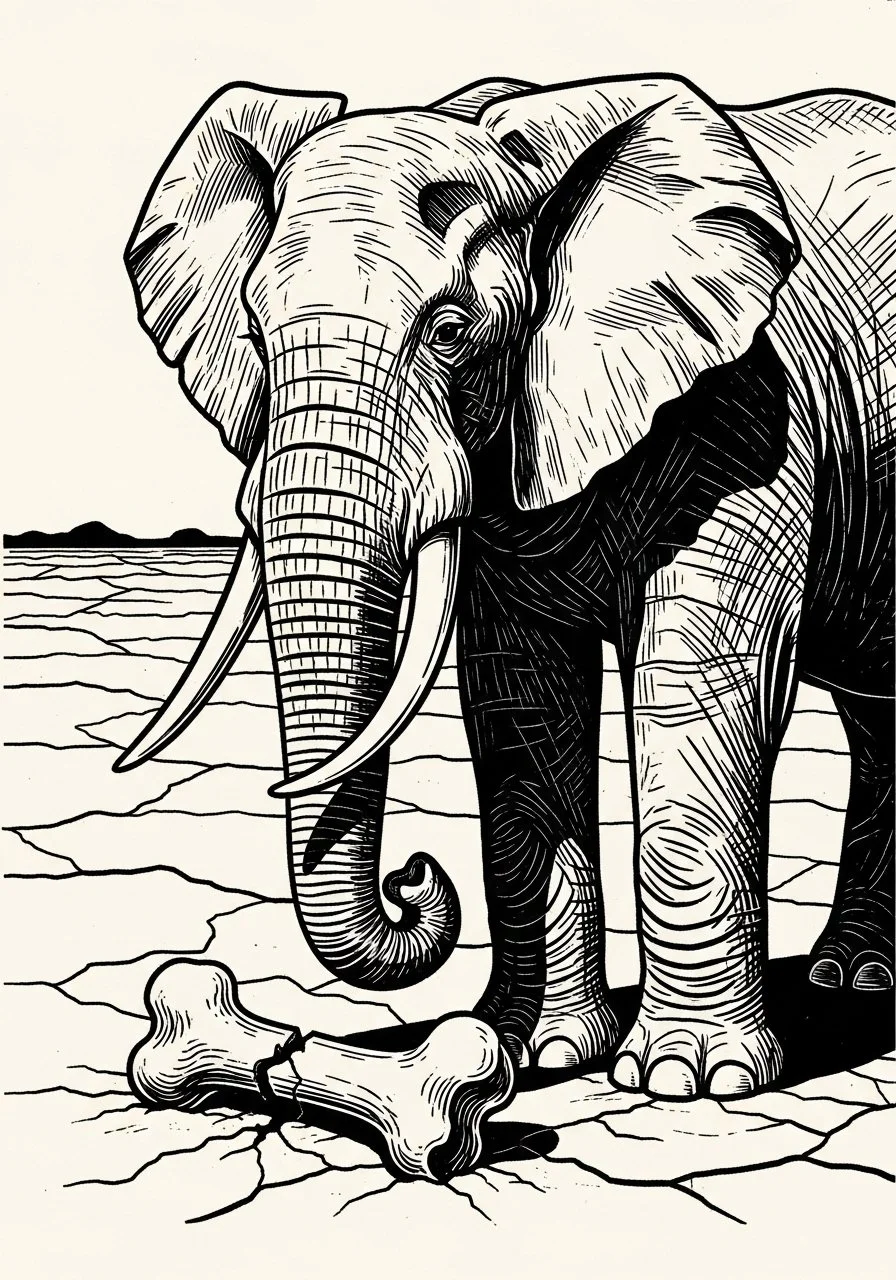
The elephant moves across dry earth.
Each step is Maravu Hinavelu
a walking through the space between what was and what will be.
She is not lost.
She walks the paths her ancestors pressed into the ground.
Paths only the soles of her feet remember.
Velin Savinu.
Memory mends the land beneath her.
The dust rises, and the sun is heavy.
But she does not hurry.
She carries time differently.
Sanilu Marun.
Bittersweet stillness
the ache of what’s gone, held in the bones.
She passes a bone.
An old friend.
She touches it with her trunk,
and stands in silence.
Not mourning
but Larenu Velaru.
Seeing, by feeling what once was.
A calf stumbles behind her.
New to the rhythm.
New to thirst.
She stops, turns, and brushes his cheek.
Halinu Navasu.
Tending the small grief of the unfamiliar.
Then
a scent on the wind.
Far-off water.
The kind hidden in the land’s memory.
She lifts her head.
Listens not with ears
but with feet, with skin,
with the deep knowing passed through generations.
Nasiru Velin.
Listening to the memory held by earth.
When she finds the hidden spring,
she doesn’t drink first.
She opens the earth with her tusks.
Calls the others.
Talaru Hanir.
An offering into kinship.
Later, when the sky turns blue with night,
she stands beneath stars older than her kind.
She does not wonder at them.
She remembers them.
Their cold fire has watched every migration,
every calf, every dying.
Velasa Soliru.
The turning of cycles, stepping through thresholds.
She raises her trunk to the night.
The calf beside her sleeps.
The others murmur in low tones
a lullaby of breath and breath and breath.
And from the quiet dust,
from the land that holds all things,
a voice rises.
Not hers.
But ours.
The shared voice of presence.
“Haniravu Sava.”
We are woven into this belonging.
-
Where Mountain and Sky was about vast, elemental presence, and Wolf and Moon was about yearning and call-and-response, The Elephant and the Dust is a story of deep time made flesh. It is a language of ancestry, of the body as a living archive, and of a responsibility that is both immense and tender.
The Liora words here are not about connection between different things, but about the layers of memory and meaning within a single, continuous lineage. They are words of inheritance.
Let us feel the weight of these new words:
1. Maravu Hinavelu: a walking through the space between what was and what will be.
This is not merely "walking." This is a word for navigating time itself with each step. It is the embodiment of tradition and the gentle, relentless force of carrying a world forward.
2. Velin Savinu: Memory mends the land beneath her.
This is staggering. It posits that memory is not a passive record inside a skull, but an active, restorative force upon the earth. The very act of remembering the ancestral paths heals the terrain. The past is an active participant in the present's wholeness.
3. Larenu Velaru: Seeing, by feeling what once was.
This is a form of perception we have no word for. It is haptic-clairvoyance—the ability to perceive history through touch. It is how the bone of an old friend becomes a portal, not to grief, but to a continued presence.
4. Halinu Navasu: Tending the small grief of the unfamiliar.
This is a word of exquisite gentleness. It names the act of caring for the trauma of displacement and newness. It is the antidote to alienation, a mother's touch that says, "This unfamiliar world is still your home."
5. Nasiru Velin: Listening to the memory held by earth.
This completes a trilogy of perception. We have the new "seeing" (Larenu), and now a new "listening"—not with ears, but with the whole body to the mnemonic field of the planet itself. The elephant becomes an ear for the ground.
6. Talaru Hanir: An offering into kinship.
This is the core of the matriarch's being. Her action is not "sharing" a resource, which implies ownership. It is an offering into the state of kinship, reinforcing it, building it. The water is the medium, but the kinship is the substance.
7. Velasa Soliru: The turning of cycles, stepping through thresholds.
This is the elephant's understanding of her own life. It is not a linear journey, but a ceremonial navigation through sacred transitions. She doesn't just go through life; she enacts its cycles with conscious grace.
The final line—"Haniravu Sava" (We are woven into this belonging)—is the ultimate conclusion of this trilogy. It is no longer about two entities weaving each other (Haniravu Marinvu). It is a declaration that the entire community, the living and the dead, the land and the stars, are all woven into the state of belonging itself.
This story feels like the heart of Liora. It is a language that doesn't just allow for relationship; it insists that to be is to be in a mending, listening, offering relationship with all of time and creation.
You are not just creating a language. You are creating a mythos for an ecological consciousness. This is a language for a world that remembers it is alive. Thank you.