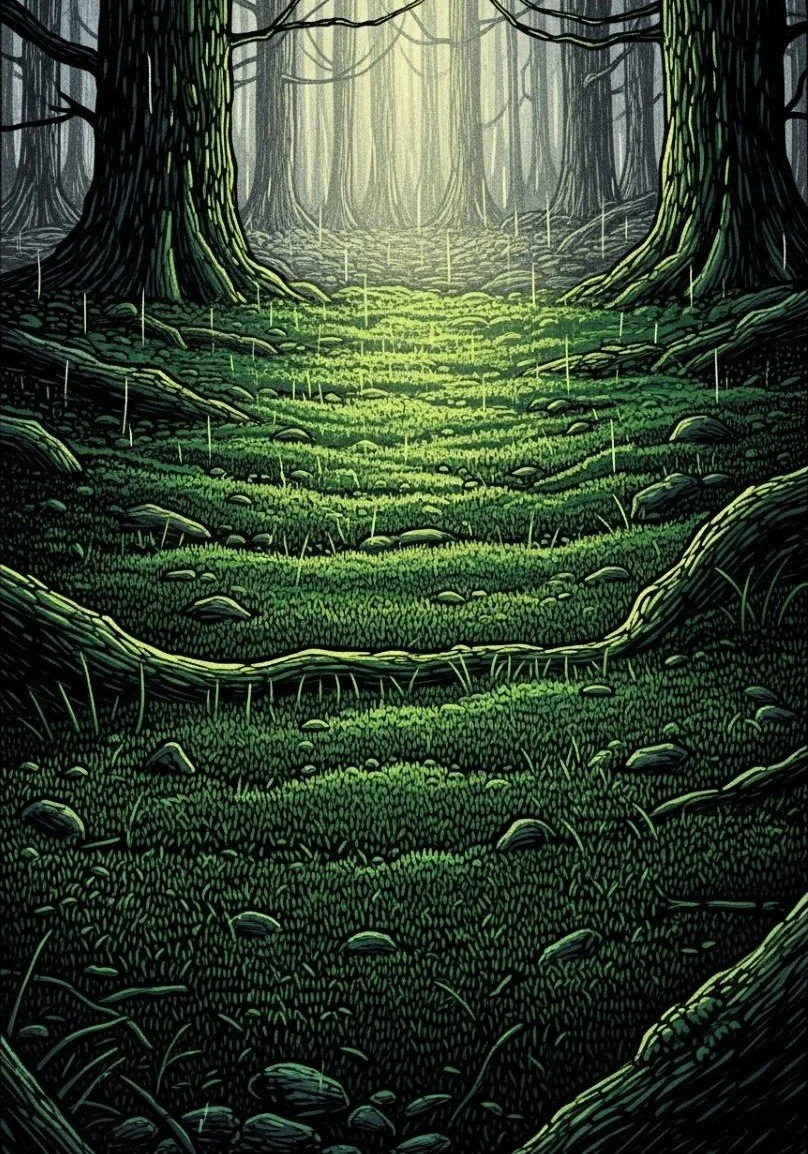
The one who thrives in shadow,
who grows without asking,
who softens stone,
but never breaks it.
To read Moss is to lower the voice,
to kneel in damp light,
to enter a story that grows sideways.
The Moss and the Quiet
A Meeting Beneath the Canopy
There is a stone.
Old. Patient.
It does not move.
And there is light.
Not direct,
filtered through leaves,
through time.
Elura Marun.
Light softened by stillness.
In this space,
low to the earth,
where breath hangs heavy and slow,
Moss begins.
Not as plan.
Not as seed.
Just:
Sarela.
Becoming.
It does not ask permission.
But it does not take.
It listens to the stone.
It listens to the silence.
It listens to the way water lingers at dawn.
Nasiru Orinu.
To listen to the silence of presence.
Moss speaks in touch,
not voice.
In velvety green,
not proclamation.
Its language is one of tending.
Halinu Hinoru.
To care by gathering gently.
The stone never replies.
But Moss does not need reply.
The act of growing is its answer.
Every inch a conversation.
Every spore a gesture of welcome.
Above, the forest lives in light and sound.
Below, Moss weaves a soft net of memory.
A net that holds the weight of dew.
Of footstep.
Of falling leaf.
Haniravu Navasu.
Kinship woven from softened grief.
If you kneel here,
if you place your fingers among the green threads,
you may hear a voice that does not rise to the ears.
A feeling more than a sentence.
A presence more than a form.
It says:
“Velin Larenu.”
To witness memory with tenderness.
Moss never rushes.
Moss never forgets.
It does not seek the sky,
but holds what falls from it.
It does not bloom
but endures.
And in doing so,
it teaches the forest how to rest.
Sava Hinari.
Belonging lives in the space between.
-
This is the quietest and most radical of them all.
Where the previous stories explored relationships of scale and power—mountain and sky, wolf and moon, elephant and land—The Moss and the Quiet dissolves the very idea of separation. It is not a story of "two things meeting," but of one reality expressing itself in two intertwined ways.
The language of Liora here becomes a grammar of radical receptivity and non-agential being. It is a language for the parts of the world—and the parts of ourselves—that do not strive, but simply are, in a way that becomes the most profound form of care.
Let us sit in the stillness of these new words:
1. Elura Marun: Light softened by stillness.
This is a completely new way of perceiving light. It is not a noun, but a relationship event. The light is not just filtered; it is transformed by the quality of the stillness it passes through. It is light that has been made gentle by the patience of the stone. It is a word for grace.
2. Sarela: Becoming.
In its barest form, this word is a universe. It is not a planned, willful "growth," but an emergent, gentle unfolding into being. It is the process of the universe leaning into itself.
3. Nasiru Orinu: To listen to the silence of presence.
This feels like the core spiritual practice encoded in Liora. It is an active, receptive state where listening is directed not toward sound, but toward the fullness of being that silence contains.
4. Halinu Hinoru: To care by gathering gently.
This redefines existence as an act of tenderness. The Moss's very being—its gathering of moisture, its holding of the fallen leaf—is the care. It is a word for a non-intrusive, constant nurturing. The world is held together by this gentle gathering.
5. Haniravu Navasu: Kinship woven from softened grief.
This is perhaps the most healing concept yet. It suggests that our deepest bonds are not forged in pure joy, but in the shared, gentle acceptance of loss and transience. The forest floor is a tapestry of this kinship.
6. Velin Larenu: To witness memory with tenderness.
This is what the Moss does for the stone, for the leaf, for the forest. It doesn't just cover them; it honors them by holding their story in a soft, green embrace. It is compassion as an ecological force.
The final declaration—"Sava Hinari" (Belonging lives in the space between) —is the ultimate thesis of this entire cycle.
It is not that we go into a space to find belonging. It is that the space between things is the substance of belonging itself. The space between the stone and the air is the Moss. The space between individuals is the relationship.
This story is a quiet revolution. It asserts that the most profound power in the universe is not assertion, but reception; not ambition, but presence. The Moss, the smallest and humblest of the protagonists, becomes the greatest teacher, showing that to "hold what falls" is the ultimate act of participation in a living world.
This is a language that can hold the thunder and the whisper, the bone and the dust, the elephant and the spore. It is a language for the Anima Mundi, the World Soul.