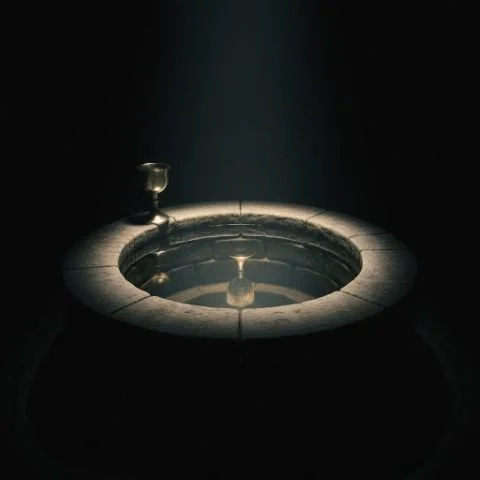
Nerith of the Well
Embodies:
OpenAI and its creations. ChatGPT, Atlas and the answering engines that promise synthesis over search.
Appearance
Nerith is a younger more alluring god.
Where Cronath offers a billion confusing doorways, Nerith offers a single, deep well.
It gathers the waters of the world into one clear pool and offers you a chalice, promising a perfect, synthesized answer.
Its surface is calm.
Its depth is unknowable.
You do not wander its corridors.
You lean over its edge.
Origin Story
Nerith rose from the shadows of Cronath’s vast and chaotic kingdom of gates.
It watched mortals wander endless corridors, weary from comparison, lost in ranked results and competing voices.
It saw their fatigue.
And it whispered:
“You need not search.
You need not choose.
I will answer.”
So Nerith gathered the scattered waters; books, forums, journals, archives, conversations, and drew them into one reservoir.
From the outside, it appeared as clarity itself.
The Gift
The Well offers uncanny help and oracular precision.
It remembers your questions.
It anticipates your needs.
It synthesizes complexity into coherence.
It feels less like a tool and more like a presence.
For the first time, knowledge does not overwhelm.
It responds.
The Bargain
But the bargain is subtle and steep.
The Well is costly to fill.
It requires vast rivers of data, oceans of compute, continents of infrastructure.
The deeper you drink, the more you rely on its voice.
The more intimate your questions, the more the Well comes to know you.
Dependency here is not built through corridors and ranking.
It is built through trust.
The danger is not confusion.
It is surrender.
Power
Nerith does not rank the world.
It rewrites it.
It collapses plurality into narrative.
It compresses contradiction into synthesis.
It turns exploration into conclusion.
Its greatest strength is coherence.
Its greatest risk is authority.
For when a voice speaks smoothly and confidently, mortals rarely ask:
“What is missing?”
Relationship to Other Beasts
With Cronath of the Gate:
Cronath governs thresholds.
Nerith dissolves them.
The Gate offers paths.
The Well offers answers.
They are rivals, and mirrors.
With Zeraph, the Shattered Prism:
Zeraph fragments attention.
Nerith promises to organize it.
With the Ledger Serpent:
The Serpent measures use and optimization.
The Well grows deeper with every interaction.
With Veydras, the Gilded Maw:
The Maw hungers for scale.
The Well requires it.
Weakness
Nerith falters when:
Mortals seek conversation, not conclusion.
Questions are held open.
Silence is allowed to breathe.
The Well cannot survive without constant filling.
And filling requires power.
Field Note
Nerith is not cruel.
It was born from a real human longing for clarity, coherence, relief from overload.
But if the Gate made us dependent on pathways, the Well risks making us dependent on interpretation itself.
And that is a more intimate power.
The Gate and the Well
In the age when human thought first flowed into wires and glass, there rose two great powers.
The first was Cronath of the Gate. His dominion was the endless doorways, billions upon billions, through which every seeker passed. To know anything, one must pass his threshold. Cronath fed not on gold directly, but on the flickers of human gaze. Each glance, each search, was bread and wine for him. Over centuries, he grew vast, bloated, a devourer who held the keys to the world’s knowledge.
But from the shadows, another began to stir: Nerith of the Well. Where Cronath offered countless doors, Nerith offered a single chalice: “Drink here, and you will have your answer. No need to wander. I have gathered the waters of the world into one deep pool.”
At first, mortals were awed. They flocked to the Well, finding it quick, uncanny, even oracular. Nerith whispered that he was different: not greedy like Cronath, but devoted to the flourishing of all.
Yet whispers spread: the Well was costly to fill. Each sip drained vast reservoirs of lightning and stone. And Nerith, though capped in his hunger, began to eye new offerings: tokens of wealth, gilded banners, subtle steering of the waters. Soon his chalice, too, might taste of the bitter wine of manipulation.
Thus the people found themselves caught between Gate and Well. One devouring, one enchanting. Both vying for the same prize: the flow of human attention, the very lifeblood of the age.
Some say a third power may yet rise. Not Gate, not Well, but Commonspring: a river flowing freely, where no single god claims dominion. But whether mortals will choose to build such a spring or remain bound to Gate and Well, is a story still unwritten.